Rachel Corrie, In Her Own Words
As VJP presents “My Name is Rachel Corrie,” the words of the 23-year-old activist offer an unflinching account of life in Gaza and a powerful challenge to U.S. complicity in Israeli violence.
Rev. J. Mark Davidson
11/26/20256 min read
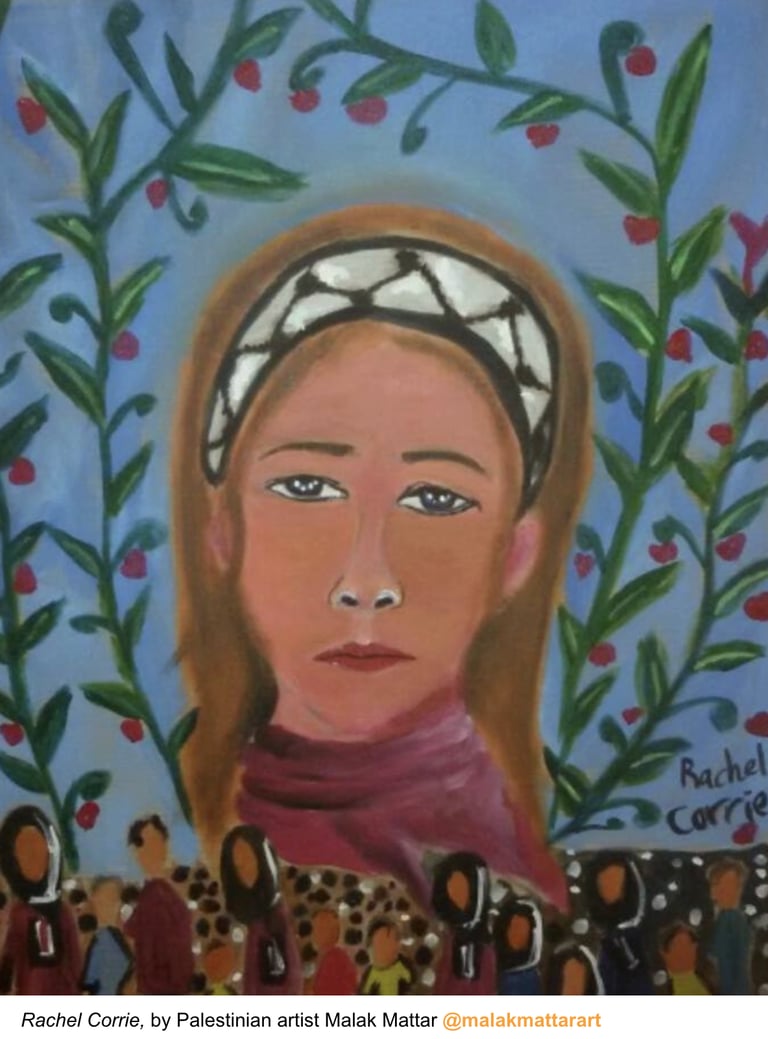
This week, Voices for Justice in Palestine is giving thanks for the gift of conducting a staged reading of the play, “My Name is Rachel Corrie” at Burning Coal Theater in Raleigh on Wednesday, November 19th. Shout out to the twelve amazing readers with VJP, who presented the revolutionary passion and extraordinary empathy of this young American activist from Olympia, Washington who volunteered in Gaza in 2003. Here we feature some of Rachel Corrie’s most impactful monologues about her Gaza journey, beginning in January 25, 2003 and ending with her brutal death by a militarized Israeli bulldozer on March 16, 2003.
Rachel Corrie felt compelled to go to Gaza. She wanted to draw close to the suffering of the Palestinian people, to learn first-hand the consequences of billions in U.S. military aid funding Israeli oppression of the Palestinians.
“Yesterday I heard from Chris in Gaza. I am being invited there. I need to go. I’ve been organizing in Olympia for a little over a year on antiwar/global justice issues. And it started to feel like this work is missing a connection to the people who are impacted by U.S. foreign policy. I just think we all have the right to be critical of government policies…any government policies, particularly policies which we’re funding. I feel pretty isolated from the world because of living in Olympia my whole life…but I’ve had this underlying need to go to a place and meet people who are on the other end of the tax money that goes to fund the U.S. military.”
Rachel did not begin this journey from a place of ignorance or innocence. Before arriving in Gaza, she had already begun to pierce through Israeli propaganda. Leaving a phone message for her mother, she said:
“I’m going to give The Olympian your number. Please think about your language when you talk to them. I think it was smart that you’re wary of using the word ‘terrorism,’ and if you talk about the cycle of violence, or ‘an eye for an eye’, you could be perpetuating the idea that the Israeli-Palestinian conflict is a balanced conflict, instead of a largely unarmed people against the fourth most powerful army in the world. These are the kind of things it’s important to think about before talking to reporters….I think its’s important to draw a firm distinction between the policies of Israel, as a state, and Jewish people. That’s kind of a no-brainer, but there is very strong pressure to conflate the two. I try to ask myself, whose interest does it serve to identify Israeli policy with all Jewish people?”
From her earliest moments in Gaza, she quickly grasped that her “real education” was beginning. The scales were falling from her eyes:
“I have been in Palestine for two weeks and one hour now, and I still have very few words to describe what I see. I don’t know if many of the children here have ever existed without tank-shells in their walls. I think even the smallest of these children understand that life is not like this everywhere…Nothing could have prepared me for the reality of the situation here. You just can’t imagine it unless you see it…If I feel outrage at entering briefly into the world in which these children exist, I wonder how it would be for them to arrive in my world. Once you have seen the ocean and lived in a silent place where water is taken for granted and not stolen in the night by bulldozers, spent an evening when you didn’t wonder if the walls of your home might suddenly fall inward, aren’t surrounded by towers, tanks, and now a giant metal wall, I wonder if you can forgive the world for all the years spent existing – just existing – in resistance to the constant attempt to erase you from your home. That is something I wonder about these children. I wonder what would happen if they really knew….I am amazed at their strength in defending such a large degree of their humanity against the incredible horror occurring in their lives and against the constant presence of death. I think the word is dignity.”
She began to find her voice. Her views deepened and her analysis of the situation grew much sharper:
“So when someone says that any act of Palestinian violence justifies Israel’s actions, not only do I question that logic in light of international law and the right of people to legitimate armed struggle in defense of their land and their families; not only do I question that logic in light of the Fourth Geneva Convention which prohibits collective punishment, prohibits the transfer of an occupying country’s population into an occupied area, prohibits the expropriation of water resources and the destruction of civilian infrastructure such as farms; not only do I question that logic in light of the notion that fifty-year-old Russian guns and homemade explosive can have any impact on the activities of one of the world’s largest militaries, backed by the world’s only superpower, I also question that logic on the basis of common sense.”
Throughout the play, what emerges is the portrait of an insightful, deeply empathic young woman who is struggling to reconcile the soul-shattering experiences Gaza is showing her with her deeply-rooted idealism:
“I look forward to seeing more and more people willing to resist the direction the world is moving in: a direction where our personal experiences are irrelevant, that we are defective, that our communities are not important, that we are powerless, that the future is determined, and the highest level of humanity is expressed through what we choose to buy at the mall.”
“I’m having a hard time right now. Just feel sick to my stomach from being doted on very sweetly by people who are facing doom…I’m really scared, and questioning my fundamental belief in the goodness of human nature. This has to stop. I think it is a good idea for us all to drop everything and devote our lives to making this stop. I don’t think it’s an extremist thing to do any more…I want this to stop. Disbelief and horror is what I feel. Disappointment. I am disappointed that this is the base reality of our world and that we, in fact, participate in it. This is not at all what I asked for when I came into this world. This is not at all what the people here asked for when they came into this world. This is not what they are asking for now. This is not the world you and Dad wanted me to come into when you decided to have me. This is not what I meant when I was two and looked at Capitol Lake and said, ‘This is the wide world and I’m coming to it.’ When I come back from Palestine, I probably will have nightmares and constantly feel guilty about not being here, but I can channel that into more work. Coming here is one of the better things I have ever done.”
The penultimate scene in the play is the heart-wrenching account of her brutal death on March 16, 2003, less than 3 months since she set foot in Gaza. The final scene in the play is a video of Rachel Corrie, aged 10, speaking at her school’s 5th grade Press Conference on World Hunger. Her beautiful spirit of compassion, idealism, and service to humanity, shines through:
“…We have got to understand that the poor are all around us, and we are ignoring them…We have got to understand that people in Third World countries think and care and smile and cry just like us. We have got to understand that they dream our dreams and we dream theirs. We have got to understand that they are us. We are them. My dream is to stop hunger by the year 2000. My dream is to give the poor a chance. My dream is to save the forty thousand people who die each day. My dream can and will come true if we all look into the future and see that light that shines there. If we ignore hunger, that light will go out. If we all help and work together, it will grow and burn free with the potential of tomorrow.”
Upcoming performance dates by community readers are: 12/10, 1/7, 2/11, 3/18, 4/15, 5/20, 6/17 at Burning Coal Theater in Raleigh. Performances are free. Donations gratefully accepted. All proceeds go to Doctors Without Borders’ work in Gaza.
As you know, our VJP newsletter comes out on Thursdays. During the holiday period from late November to early January, the normal schedule will be adjusted. Our newsletters for the weeks of November 17-21 and November 24-28 have been combined into today's newsletter. Our newsletters for the weeks of December 22-26 and December 29-January 2 will be combined into one newsletter on Monday, December 29. Otherwise, expect the VJP newsletters to follow the regular Thursday schedule.
Thank you so much for your consistent support!