This is Not Peace
The Trump plan offers temporary quiet while avoiding the root causes of the conflict, sidelining justice, and leaving the conditions for lasting peace unresolved.
Rev. J. Mark Davidson
10/16/20252 min read
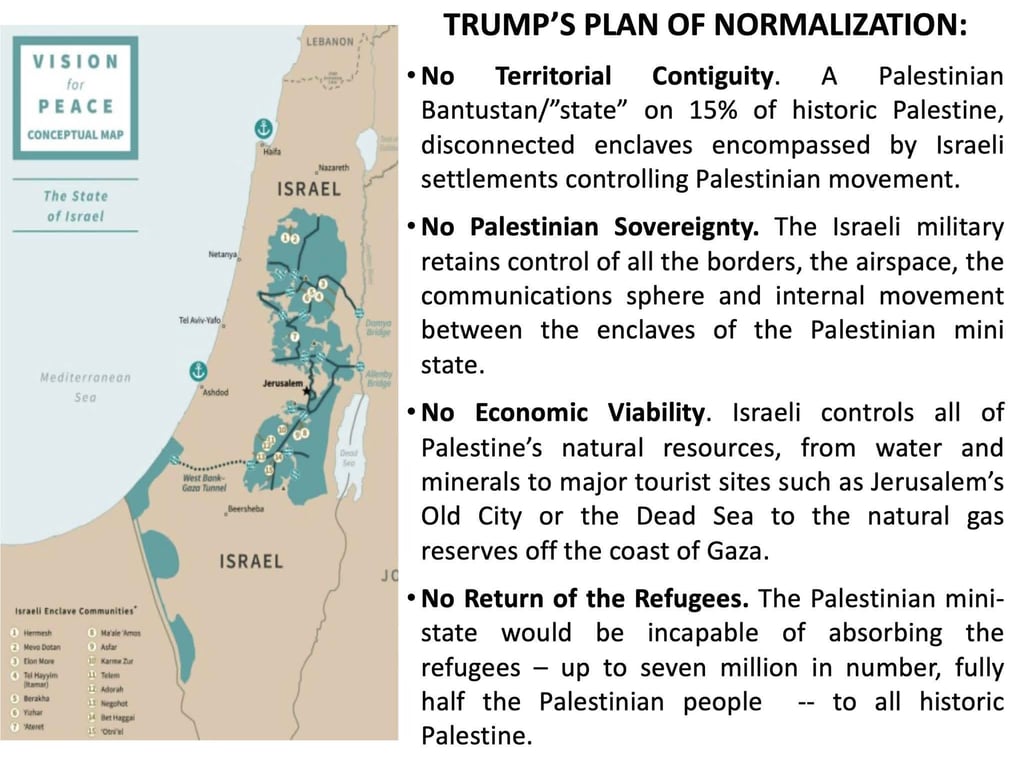
Israeli anthropologist and peace activist, Jeff Halper, is fond of saying, “Most Israelis don’t want peace, they want peace and quiet.” It seems that’s as true as ever. One thing is sure: the Trump so-called “peace plan” may bring a kind of temporary peace and quiet. But it fails utterly to address the root causes of the Palestinian-Israeli conflict. “Peace” is too good, too strong, too promising a word to use to describe this plan. As Dr. King reminded us decades ago, peace is not merely the absence of violence; peace is “the presence of justice.” Indeed, as the saying goes, “if you want peace, work for justice.” The Trump-Netanyahu plan does not begin to do that. Justice demands at least these five things:
a permanent ceasefire with ironclad guarantees preventing a resumption of violence,
withdrawal of Israeli forces from Gaza and the lifting of the Israeli blockade,
accountability for war crimes and genocide - indicted war criminals arrested and brought to trial at the International Criminal Court
restitution for the grave losses the Palestinians in Gaza have suffered, and
reconstruction of Gaza to ensure the long-term viability and self-determination of the people of Gaza, the occupied West Bank, and East Jerusalem.
There is no denying that the traumatized families of captives held by Hamas and Islamic Jihad and by Israel ecstatically welcome the return of their loved ones, and the end of this long ordeal. Without doubt, the devastated population of Gaza welcomes the cessation of nightly bombings, but sadly they have no confidence that the skies will not soon reignite with fire and terror. The starving people of Gaza welcome the increase of humanitarian aid, but have no reason to trust that the gates will remain open and the trucks continue to enter the Gaza Strip. In fact, Israel has already acted unilaterally to cut in half the number of trucks allowed in.
While the elements of a just and lasting peace have again been shoved off into the indefinite future, we can at least hope that the genocide is finally over. If that proves to be true, it may open the door to thoughtful reflections about these last two years, and new openings for the future. So many questions abound:
Can we come to clarity about what we have witnessed?
Has Israel irretrievably and publicly debased itself by its cruelty toward the Palestinian people?
What is the state of the Palestinian national movement in the wake of the destruction of Gaza?
How can a powerful global movement for Palestinian liberation (and collective liberation) pivot toward the long-term work of building a just and lasting peace?
I am wrestling with cynicism in myself. I want to be hopeful. In that vein, I remember the powerful words of the Czech dissident, playwright, and president for the Czech Republic, Vaclav Havel: “Hope is not a state of the world. It is a state of mind. It is not a prognostication, an estimation of the state of the world. It is an orientation of the spirit.”